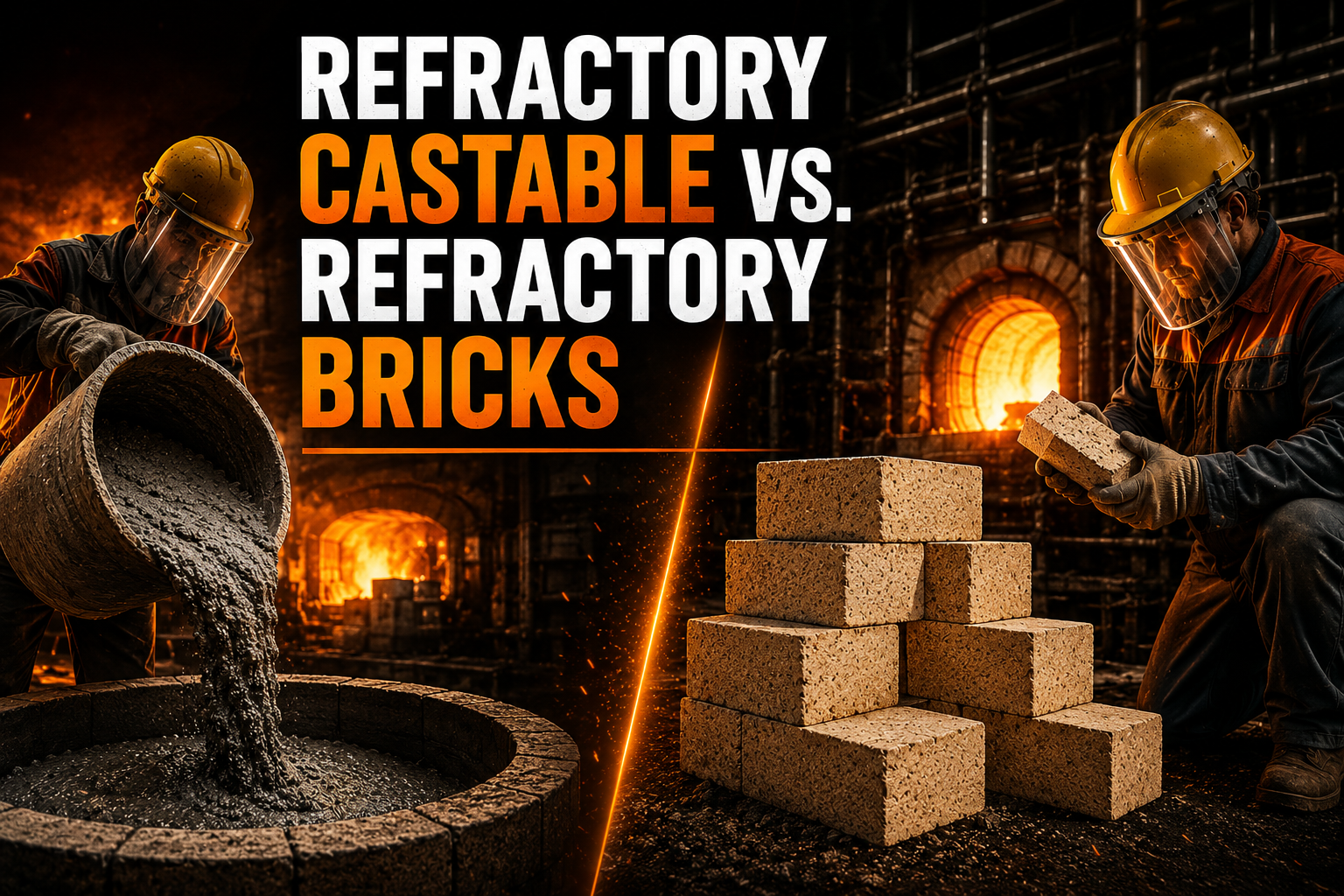
When designing or maintaining high-temperature industrial equipment like a rotary kiln, furnace, or boiler lining, picking between refractory castable and refractory bricks is one of the most important choices that needs to be made. Both materials are engineered to withstand extreme heat, chemical attack, and mechanical stress. But they perform very differently depending on the application, geometry, and operating conditions.
In this blog we are going to see Refractory Castable vs Refractory Bricks and learn more about each type along with all the pros and cons.
Key Takeaways
- Choosing between refractory castable and refractory bricks is not a matter of which is better; it is about picking the right material for the job.
- For complex shapes, curved surfaces, and large-scale industrial installations, refractory castable makes a monolithic lining that doesn’t have any seams or joints.
- When it comes to high-wear areas, slag contact areas, and uses that can’t wait for the bricks to cure, refractory bricks are the best choice.
- When there are no joints, there are fewer places where things can go wrong. Castable linings are better at stopping gas leaks, chemical attacks, and thermal cracking than brick-and-mortar systems when temperatures change.
- High alumina castable refractory and high-grade fire bricks can both handle temperatures above 1600°C, so the temperature shouldn’t be the only thing that you think about.
- Installing castables is faster and cheaper because they can be poured or gunned by a small team, while installing brick lining takes more time and skilled masons.
- When you use refractory bricks to fix something, you can replace just the bricks that are worn out without affecting the rest of the lining. This is not possible with a monolithic castable structure.
- Both insulating bricks and insulating castables can be used as backup lining, but castables can be shaped to fit uneven surfaces better without having to be cut or shaped.
What is Refractory Castable?
Refractory castable material is a dry, pre-mixed blend of refractory aggregates (alumina, silica, magnesia), binders such as calcium aluminate cement, and chemical additives. On-site, it is mixed with water and then cast, poured, or gunned into position, where it hardens into a monolithic, seamless lining.
Common types of Refractory Castables include high-alumina castable refractory for zones exceeding 1600°C, dense refractory castable for abrasion-heavy areas like ladle linings, insulating castable for backup and heat conservation linings, and low-cement variants for premium mechanical strength.
What are Refractory Bricks?
Fire bricks, which are another name for refractory bricks, are pre-fired, pre-shaped blocks that are made in controlled kiln environments. Composed of fire clay, high alumina, silica, or magnesia, they are sintered at high temperatures before delivery, resulting in a dense, durable product with defined geometry.
Popular categories include high alumina bricks (45–99% Al₂O₃) used in steel ladles and blast furnaces; insulating fire bricks for lightweight backup linings; silica bricks for coke ovens and glass tank crowns; and outdoor fire bricks for pizza ovens, fireplaces, and recreational kilns.
To understand how these bricks perform under extreme chemical and thermal stress, read our detailed guide on refractory bricks for aluminum smelting.
Refractory Castable vs Refractory Bricks: Head-to-Head Comparison
| Feature | Refractory Castable | Refractory Bricks |
| Installation | Poured/gunned on-site; no skilled masonry needed | Requires skilled bricklayers and refractory mortar |
| Shape Flexibility | Excellent as it fills any complex geometry | Limited to standard brick shapes |
| Seams & Joints | Monolithic, no joints. Fewer weak points | Multiple mortar joints. Potential leak paths |
| Thermal Shock Resistance | Good (varies by grade) | Excellent (especially dense bricks) |
| High-Temperature Limit | Up to 1800°C+ (high alumina castable) | Up to 1800°C+ (high-grade fire bricks) |
| Repair & Maintenance | Easy to patch or cast sections | Individual brick replacement possible |
| Curing Time | Requires curing and dry-out period | Ready to use immediately after laying |
| Cost (Material) | Generally lower upfront cost | Higher unit cost for specialty bricks |
| Cost (Labour) | Lower and faster installation | Higher and skilled masons required |
| Best For | Complex shapes, curved linings, new installs | Wear zones, high-pressure areas, precision linings |
Benefits of Refractory Castable Over Refractory Bricks
Here are some of the benefits of refractory castables compared to refractory bricks:
Superior Shape Adaptability
Industrial equipment is rarely simple. Cyclone chambers, burner tips, tundish covers, and arched furnace roofs all demand a lining that conforms perfectly. Refractory castable installation eliminates the need for custom-cut bricks by flowing into every contour, reducing scrap and installation time significantly.
Monolithic Integrity. No Joint Failures
Every joint in a brick lining is a potential failure point. Under thermal cycling, mortar expands and contracts differently than the brick body, leading to cracking, gas infiltration, and chemical attack. When properly cured, a castable lining doesn’t have any joints; the whole structure acts like a single block, which makes it last a lot longer in environments where temperatures change.
Faster Installation and Lower Labour Costs
Castable refractory cement systems can be gunned or vibration-cast by a small team with standard equipment. Comparable brick lining jobs require experienced masons working for considerably longer durations. For large-scale industrial shutdowns where downtime directly means lost revenue, the speed advantage of castables is substantial.
Cost-Effectiveness for Complex Applications
High-quality castable can cost as much per kilogram as bricks, but the total cost of installation is almost always less for castables in complex shapes, even when labor, custom shapes, and waste are taken into account. For straightforward flat walls in stable-temperature zones, bricks may offer better value per unit area.
Advantages of Refractory Bricks for High-Temperature Applications
Refractory bricks are far from obsolete. Their advantages in specific scenarios make them indispensable.
Areas exposed to slag impact, abrasion from hot metal, or corrosive dust benefit enormously from the dense, pre-sintered structure of high-quality fire bricks. In brick-lined furnaces, a broken part can be replaced brick by brick without affecting the whole lining. This is a significant maintenance advantage compared to a castable lining that is a single, solid piece.
Bricks carry no curing requirement and are ready to operate immediately after installation, whereas castable linings require a controlled dry-out process that can take 12–72 hours depending on thickness and grade.
In blast furnace stacks and converter vessels, the mechanical strength of dense, high-temperature bricks under sustained load is also difficult to match with standard castables. From steel furnaces to cement kilns and beyond, explore the full range of uses of refractory bricks across modern industrial processes
When to Use Refractory Castables Instead of Refractory Bricks?
The following conditions favor castable over bricks: any furnace zone where brick cutting would be extensive due to complex or irregular shapes; large monolithic linings such as cement rotary kilns, incinerators, and petrochemical reactor linings; quick shutdown turnarounds where speed of installation outweighs curing time; patching and spot repairs on existing brick or castable linings; and weight-sensitive structures like roof linings and hanging spans where load reduction is critical.
Why Does Ganesha Refractory Recommend a Hybrid Approach?
In practice, the most efficient and durable furnace linings often combine both materials. At Ganesha Refractory, engineers frequently design linings where high-alumina castable refractory is used for curved sections, roof spans, and complex geometries, while dense insulating bricks and high-temperature bricks protect the critical wear zones near burners, slag lines, and tap holes.
In most of the structure, this hybrid method gives the seam-free strength of castable while keeping the mechanical toughness of bricks where it matters most. It also lets you do zone-specific maintenance, like replacing bricks in worn areas without touching the monolithic castable parts.
Whether you are lining a new furnace, relining a kiln, or troubleshooting premature wear in an existing structure, the Ganesha Refractory team brings decades of combined experience across steel, cement, glass, and petrochemical sectors to guide your material selection and installation.
Conclusion
There is no clear winner in the argument between refractory castables and refractory bricks. Each situation calls for a different answer. Castables are the most flexible, monolithic, and quick to install option on the market. Bricks are known to be tough, don’t need to be cured, and have exact geometry in areas that get a lot of use.
Matching the material to the zone is always the best thing to do, and Ganesha Refractory always says that. Before choosing either solution, you should know about your temperatures, geometry, chemical environment, and maintenance philosophy. If you’re not sure what to do, talk to a refractory engineer who has worked with both materials before and knows them inside and out.
Frequently Asked Questions
What is the difference between refractory castables and refractory bricks?
Refractory castable is a monolithic, poured-in-place material that hardens into a seamless lining. Refractory bricks are pre-fired, pre-shaped blocks laid with mortar. Castables offer shape flexibility and no joints; bricks offer immediate use and easier zone-by-zone replacement.
Which is better: refractory castable or refractory bricks?
Neither is universally superior. Castables excel in complex shapes, curved surfaces, and large monolithic installs. Bricks are preferred for wear zones, high-pressure areas, and applications requiring no curing downtime. A hybrid design often provides the best overall results
What are the advantages of refractory castables?
Key advantages include no joints, fast installation with lower labor costs, adaptability to complex geometries, easy patching capability, and availability in insulating or dense grades for varied thermal requirements.
What are the advantages of refractory bricks?
Refractory bricks provide immediate service readiness, proven abrasion resistance, easy targeted replacement, precise dimensions, and superior performance under sustained mechanical load in slag and metal contact zones
Are refractory castables more cost-effective than refractory bricks?
When it comes to most complicated or large-scale uses, yes. Castables usually have a lower total installed cost because they require less work and don’t need to be cut to order. For stable, simple flat walls, bricks may be a better value per square meter