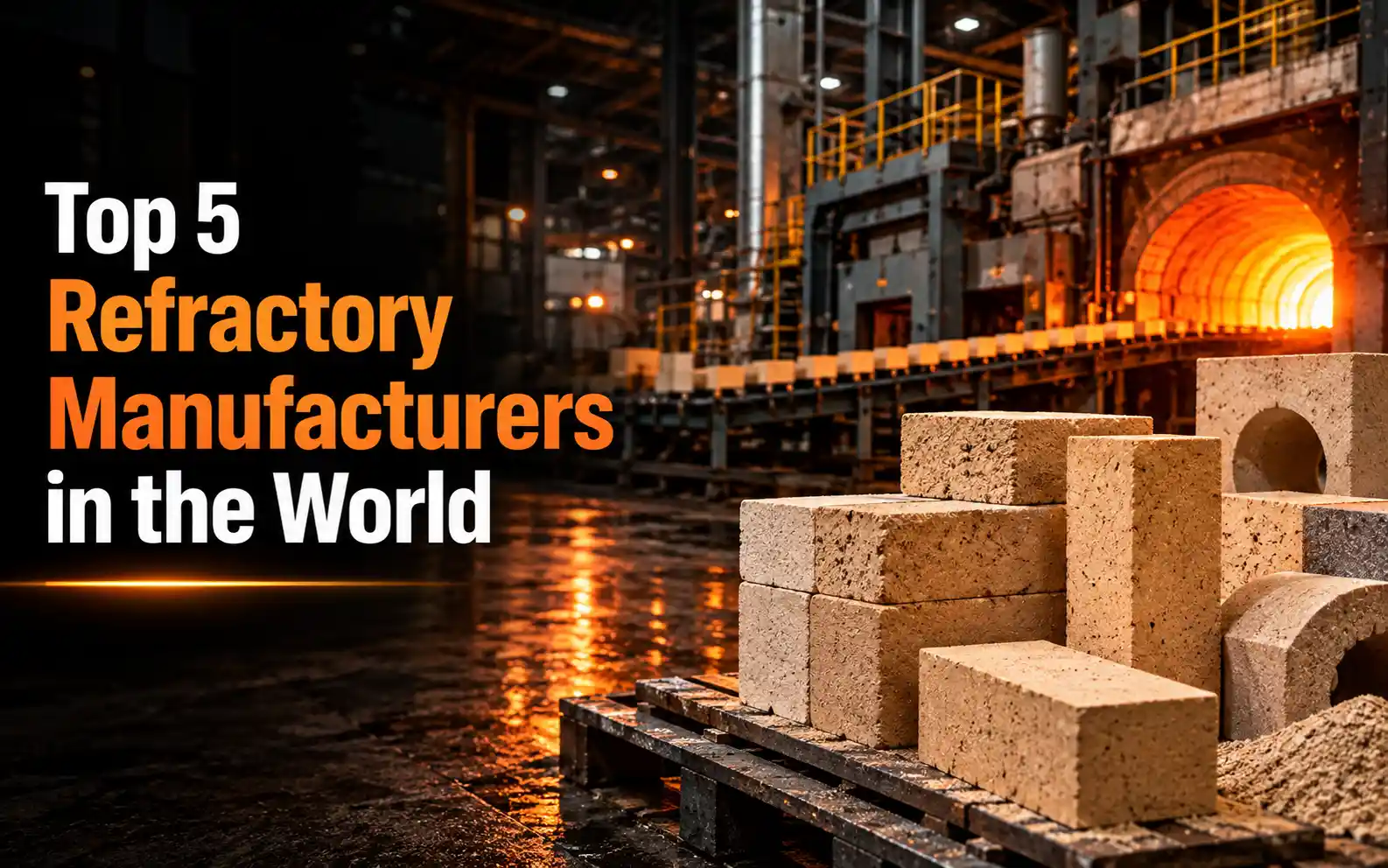
Refractory materials are the backbone of high-temperature industrial processes. Without them, furnaces, kilns, boilers, and reactors could not operate at the temperatures that modern manufacturing demands. From the steel and cement industries to glass production and power generation, every sector that works with extreme heat depends on reliable refractory products to protect equipment, contain heat, and maintain operational safety.
Selecting the right supplier starts with understanding who leads the global market. Whether you need a refractory fire brick manufacturer for furnace lining or a complete refractory solution for an industrial project, knowing which companies set the benchmark for quality and reliability helps you make better procurement decisions.
Here are the top 5 refractory manufacturers in the world that consistently rank among the best worldwide.
Key Takeaways
- A small number of companies lead the global refractory market, backed by decades of industrial expertise and international operations.
- Each leading manufacturer offers a distinct product range suited to specific industries and high-temperature applications.
- Company scale, product breadth, and technical support capability are the key factors that distinguish top-tier suppliers.
- India has a growing presence in the global refractory market, with manufacturers supplying both domestic and international industrial sectors.
- Choosing the right refractory supplier depends on your application, required product specifications, and the level of technical support your project demands.
Refractory Manufacturers in the World
Here are some of the top 5 refractory manufacturers in the world:
1. Ganesha’s Refractory
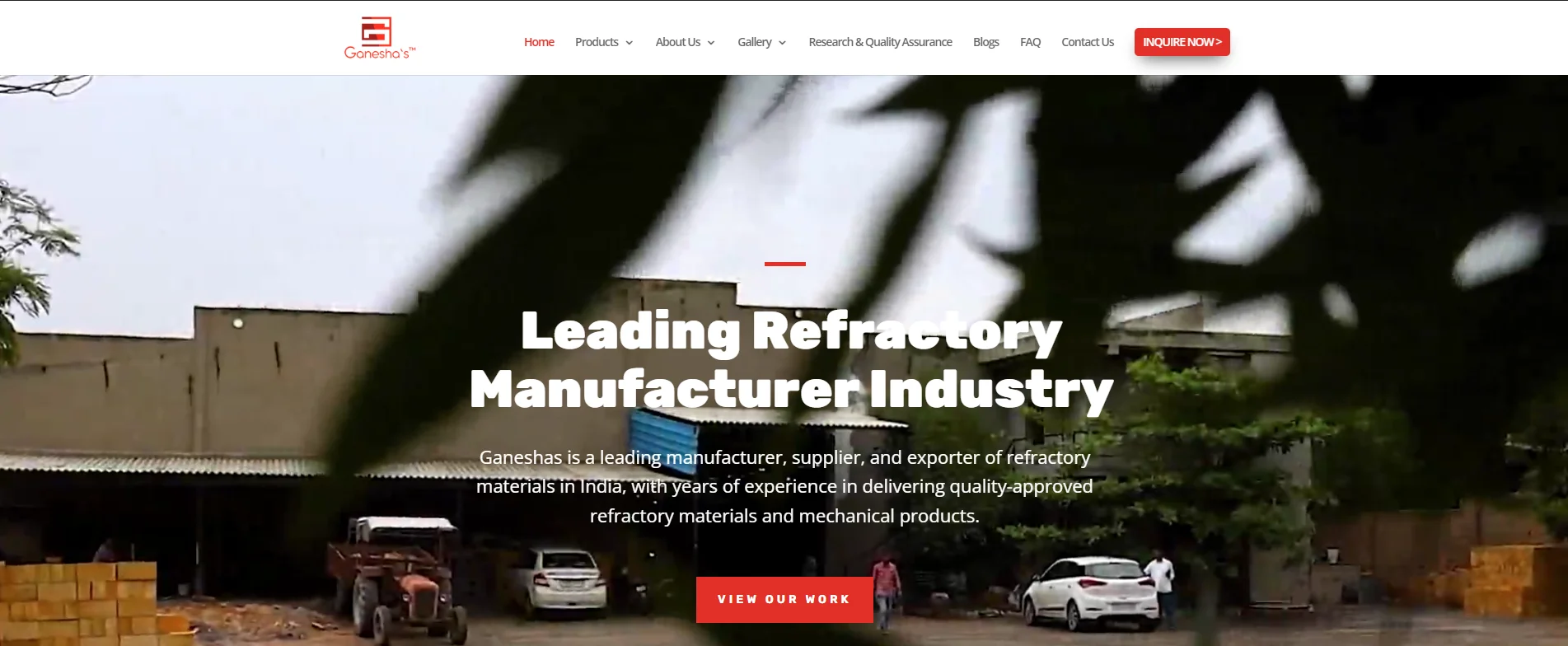
Ganesha’s Refractory is an established Indian manufacturer and supplier of a comprehensive range of refractory products serving the steel, cement, glass, and power generation industries. The company produces both shaped and unshaped refractory materials and supplies industrial clients across India and international markets. Its product range centres on the core materials high-temperature industries depend on, manufactured to consistent technical standards with reliable domestic supply chain support.
The company’s offering includes refractory castables suitable for lining industrial furnaces, kilns, and boilers, alongside bricks for chemical processing environments that require both thermal and chemical protection. This breadth makes Ganesha’s Refractory a capable single-source supplier for projects with varied refractory requirements across different zones of the same installation.
For power generation and thermal processing applications, Ganesha’s Refractory supplies boiler bed material engineered to withstand the abrasive and high-temperature conditions inside boiler systems. The company also produces fire clay powder, a fundamental raw material in refractory manufacturing used in bricks, mortars, and monolithic linings across industrial applications.
- Full product range covering fire bricks, castables, acid-resistant bricks, fire clay, and boiler bed materials.
- Serves the steel, cement, glass, power generation, and chemical processing sectors.
- Indian manufacturer with reliable domestic supply and competitive lead times for South Asian industrial projects.
2. RHI Magnesita
RHI Magnesita is the world’s largest refractory manufacturer by revenue and production volume. Headquartered in Vienna, Austria, the company was formed in 2017 through the merger of RHI AG and Magnesita Refratarios. It operates over 35 production sites across more than 15 countries and supplies refractory products to the steel, cement, glass, and non-ferrous metals industries globally.
The company’s product range covers shaped and unshaped refractory materials, including refractory castables, basic bricks, and monolithic linings. Its global scale allows it to serve major industrial clients with consistent supply, technical engineering support, and on-site installation services across project types.
- Global production capacity exceeds 2.5 million tonnes annually.
- It serves the steel, cement, glass, lime, and energy industries.
- Offers full lifecycle services from product supply to furnace lining maintenance.
3. Imerys
Imerys is a French multinational and one of the world’s leading producers of refractory material derived from industrial minerals. The company mines, processes, and refines raw materials including kaolin, andalusite, and bauxite to produce a comprehensive range of refractory and ceramic products. It serves the steel, glass, cement, and foundry industries across more than 50 countries.
A significant part of Imerys’s refractory output involves fire clay-based products. Fire clay powder is a fundamental raw material in refractory manufacturing, used to produce fire bricks, mortars, and monolithic linings. Imerys’s control over the full mineral processing chain, from mining to finished product, gives it a consistent quality advantage in this area.
- One of the world’s largest producers of high-purity industrial minerals for refractory use.
- Full vertical integration from raw material extraction to finished product.
- A key supplier to the glass, steel, and foundry industries, with a strong focus on environmental sustainability.
4. Morgan Advanced Materials
Morgan Advanced Materials is a UK-based company specialising in high-performance refractory and thermal management materials. The company produces ceramic fibres, refractory boards, and specialty insulation products for extreme temperature environments. Its products are used in industrial furnaces, kilns, aerospace applications, and semiconductor manufacturing.
Morgan’s product range includes solutions for corrosive and chemically aggressive environments. For industries where chemical resistance is a priority alongside thermal performance, products equivalent to acid resistant bricks and chemically resistant linings form a critical part of the product offering. This makes Morgan particularly relevant to the chemical processing, petrochemical, and waste treatment sectors.
- Specialises in advanced ceramic and thermal management solutions for precision industries.
- Serves aerospace, semiconductor, industrial furnace, and chemical processing markets.
- Known for innovation in high-performance insulating fibre and specialty board products.
5. Krosaki Harima Corporation
Krosaki Harima Corporation is a Japanese refractory manufacturer founded in 1918 and headquartered in Kitakyushu, Japan. Backed by parent company Nippon Steel Corporation, the group operates over 20 production plants across Japan, India, Europe, and China, serving the iron and steel, glass, chemical, and cement industries worldwide.
The company’s product range covers blast furnace, coke oven, steel ladle, continuous casting, and oxygen converter refractories, as well as unshaped and functional refractories for kilns and industrial furnaces. Krosaki Harima also produces advanced ceramic materials, including NEXCERA, a low-thermal-expansion ceramic used in semiconductors, communications devices, and automotive applications.
- Over a century of refractory expertise with global manufacturing presence across four continents.
- Serves the iron and steel, glass, chemical, cement, and power generation sectors.
- Offers shaped and unshaped refractories, plus specialty ceramic solutions for precision industrial applications.
Tips to Remember When Choosing a Refractory Manufacturer
Choosing the right refractory manufacturer affects your industrial operation’s long-term performance and safety. Keep these practical considerations in mind before you commit to a supplier.
- Match the manufacturer to your industry. Not all refractory companies serve every sector equally. A manufacturer with deep expertise in steel applications may not be the best fit for a glass kiln or a chemical processing plant. Confirm that the supplier has a proven track record in your specific industry.
- Evaluate product range against your application requirements. A single project may require shaped fire bricks, unshaped castables, and specialty linings across different zones. A supplier with a full product range reduces the complexity of managing multiple vendors.
- Assess technical support capability. Refractory performance depends not only on product quality but also on proper specification, installation, and maintenance. Manufacturers that offer application engineering support can help you avoid costly installation errors.
- Consider supply reliability and lead times. For industrial operations where downtime is expensive, supply consistency matters as much as product quality. Confirm the manufacturer’s production capacity, warehousing, and typical lead times before finalising a supplier.
- Check quality certifications. Look for manufacturers that operate under recognised quality management systems. Certifications indicate that the company maintains consistent production standards and can provide documentation to support project compliance requirements.
- Factor in after-sales and technical service. Refractory linings require periodic inspection, repair, and replacement. A manufacturer that provides ongoing technical service and maintains a relationship with clients after initial supply offers long-term value beyond the initial transaction.
- Request references or case studies. Established manufacturers should be able to provide references from clients in your sector. Case studies demonstrating performance in comparable applications give you a more reliable basis for evaluation than product data alone.
Final Thoughts
The top refractory manufacturers in the world have built their positions through decades of material science expertise, consistent product quality, and the ability to serve demanding industrial clients at scale. Each company on this list brings a distinct strength, whether that is global production capacity, mineral processing integration, specialised product ranges, or deep technical service capability.
For industrial buyers in India and across South Asia, quality and supply reliability matter equally. Ganesha’s Refractory is an established Indian manufacturer and supplier of refractory products including fire bricks, fire clay, refractory castables, acid-resistant bricks, and boiler bed materials. The company serves industrial clients across the cement, steel, glass, and power generation sectors with products manufactured to consistent technical standards and supported by reliable domestic supply.
Frequently Asked Questions
What are refractory materials used for?
Refractory materials line furnaces, kilns, boilers, reactors, and other equipment that operates at high temperatures.
What should I consider when choosing a refractory manufacturer?
Consider the manufacturer’s product range for your application, technical support capability, production capacity and supply consistency, quality certifications, and track record in your specific industry.
Which industries commonly use refractory products?
The steel, cement, glass, aluminium, foundry, chemical processing, petrochemical, power generation, and ceramic industries all rely heavily on refractory products.
What types of refractory products do manufacturers supply?
Refractory manufacturers supply shaped products such as fire bricks and special shapes, unshaped products including castables, mortars, and gunning mixes, insulating materials such as ceramic fibre boards and blankets, and specialty products like acid-resistant bricks and boiler bed materials.
How do I choose the right refractory product for my application?
Identify the maximum operating temperature, the chemical composition of the materials in contact with the lining, the mechanical load conditions, and any special requirements such as acid resistance or thermal insulation.