
Choosing and maintaining refractories in a new building project or during the repair of essential heat processing technologies seems to be an afterthought for many industrial plant engineers and professionals.
These designers and administrators are frequently overworked, and many lack proper refractory training.
It drives them to put refractory selection at the bottom of their “To Do” list, which often leads to misunderstandings that cost them a lot of money and result in them not obtaining qualifying results.
There are certain misunderstandings about refractory services that you should know if your industrial facility employs or needs refractory installation.
Let’s look at some of the most prevalent misunderstandings and what you should do instead to save money, time, and effort.
Common misconceptions
Regular maintenance is not needed!
Refractories are disposable and should be updated on a regular basis. They ARE going to wear out. They’re similar to your car’s brakes or tires in that they safeguard you until they fail. Considering your refractory service and maintenance routines at setup will assist you to prolong their life and minimize injuries, delays, and device failures.
Using dirty water
When making a castable, the standard norm is to utilize drinkable water. When mixing a castable, a novice contractor may use polluted water. Is this going to be a problem? Absolutely. Water containing dispersed particulates can alter the castable’s chemistry, causing it to collapse or fail prematurely.
Manufacturing is the same.
Refractory materials aren’t for everyone. The elemental composition of one manufacturer’s prefabricated refractory may differ slightly from that of another.
Chemical compositions may differ amongst products that appear to be comparable. It implies that it is critical to have a refractory expert with a lot of knowledge to help you choose suitable refractory materials for the work.
The only thing that matters is what’s on the inside.
Inside blast furnaces, boilers, kilns, biogas, and incinerators, temperature, and chemical reactions impact refractory materials, but so does the weather outdoors.
Special precautions must be taken when mixing, refractory installation, and storing castables in freezing conditions. So, in addition to what’s going on inside, consider what’s going on outside as well.
Castable refractory maintenance is unaffected by the weather.
Low temperatures influence the capacity of castables to bond, which directly impacts the implanted lining’s efficiency and durability. Precautions need to be taken by your subcontractor when mixing, installing, and storing castables.
Refractories are standardized products.
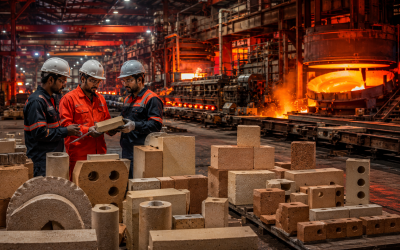
Refractory materials aren’t standardized at all. Fireclay and high aluminum refractory brickwork, Fireclay and higher alumina plastic refractories, Silica refractory bricks, Castable refractory material, alumina, and alumino-silicate, Chromium, magnesite-chrome, and Insulating firebrick are only a few examples of refractory solutions.
There are a plethora of possible permutations within these broad, high-level categories, such as variants based on the chemical composition, weight, PCE value, and stiffness of rupture worth.
Precast shapes are expensive to install
In actuality, field deployment of a precast shape system is often far more straightforward than forming and casting, necessitating less on-site machinery and fewer specialists.
The job is becoming more of a typical mechanical job with prefabricated shapes instead of a specialty job needing expert refractory solutions. Additionally, curing and drying time can be avoided, yielding considerable time and cost savings.
It would be difficult to lift and handle prefabricated shapes on the field!
When designing a precast system, one of our first considerations is lifting, handling, and manipulating precast refractory applications in the field. Choose a company that knows everything there is to know about on-site lifting abilities, equipment availability, and have qualified staff.
Wrapping up!
Keep these factors in mind the next time you plan a new building or refractory repair or maintenance project. Refractories aren’t a commodity, and choosing the right refractory solution isn’t a one-size-fits-all method.
Careful consideration and care for your staff and your company’s financial line will provide the best long-term benefits.
You’d think that considering their importance in industrial operations, everyone is familiar with refractory services. However, because of their intricacy, only an expert refractory team would be able to assist you in selecting an appropriate refractory installation for your project.
Get in touch with us to discover more about refractory choices that are right for you.