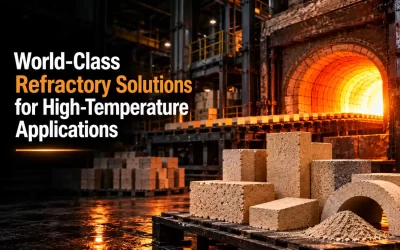

Are you familiar with refractory bricks? If you’re not, you’re missing out on an essential building material that has been used for centuries.
These are not your ordinary bricks, and they play a crucial role in various industries, including steelmaking, glass production, and more. These bricks can resist extreme heat and harsh chemical environments, making them an essential component in furnaces, kilns, and boilers.
So, what are refractory bricks, and how do they differ from regular bricks? What types of refractory bricks are available, and what are their specific uses and benefits? Join us in this blog post as we dive deeper into the world of refractory materials and discover their fascinating properties and applications.
What are Refractory Bricks & Fire Bricks?
Refractory bricks are also known as fire bricks- a type of specialized brick used in high-temperature applications, such as furnaces, kilns, and other industrial settings. They’re designed to withstand extreme temperatures and harsh conditions, making them a critical component in many industries.
In addition, there are various types of refractory bricks available in the refractory industry. Refractory bricks are used for industrial settings where high temperatures are required, such as in furnaces, kilns, boilers, and incinerators. They provide thermal insulation, prevent heat loss, and protect the metal or other materials inside the container from damage.
What are the types of Refractory Bricks?
There are different types of refractory materials available in the refractory industry but they are divided into three main categories. Have a look!
Basic Refractory Bricks: Magnesite blocks, Dolomite blocks, Bauxite blocks.
Acidic Refractory Bricks: Ordinary fire block, Silica bauxite block, Ganister block.
Neutral Refractory Bricks: Chromium blocks, Carborundum, Chrome magnesite blocks, Spinal blocks, and Forsterite blocks.
What are the Benefits of Refractory Bricks?
The following are some noteworthy advantages of refractory bricks and fire bricks that you should definitely check.
Insulating Nature: Refractory bricks are widely known for their insulating properties
High Temperature Resistant: The Refractory bricks can withstand up to 2100 degrees Celsius high temperature
Flexible Using: The refractory bricks are suitable for use in the masonry construction process.
No Skilled Labor Required: The refractory bricks layering process doesn’t demand highly skilled labor
Smooth Manufacturing Process: The refractory bricks AKA fire bricks manufacturing process is very smooth and easy.
Absorbs Water Quickly: The refractory bricks have water-resistant properties.
What are the Uses of Refractory Bricks

Fire bricks/fire clay bricks withstand high temperatures, with fusion points exceeding 2100°C. As a result, it’s ideal for lining furnaces as fire bricks and building metalworking equipment. The following are some other major uses of refractory bricks and fire bricks
- In the construction of fireplaces, wood stoves, and pizza ovens, fire bricks, and refractory bricks are used for withstanding high temperatures and preventing heat loss.
- Firebricks are used in industrial boilers and furnaces to melt and heat materials at very high temperatures.
- As fire bricks insulate the heat and prevent damage to kiln walls, they are commonly used in pottery mills or other heat treatment processes.
- In order to provide insulation and stop the spread of fire to the surrounding area, they are used in the construction of chimneys.
- Fire bricks are perfect for lining a forge’s interior walls because they can withstand high temperatures and act as insulation to hold onto heat, allowing for effective blacksmithing.
- As a safeguard and insulator, fire bricks are crucial in buildings that subject materials to extreme heat. Refractory clay is widely used in the firing process to increase both its melting point and heat resistance.
Refractory Material Characteristics
The following are some important characteristics of refractory bricks also known as fire bricks. Have a quick look.
- Refractory bricks are either pale yellow or white in color.
- The dimensions of refractory bricks range from 9 X 4.5 X 2.5 inches to 9 X 2.75 X 2.25 inches.
- A common fire brick weighs anywhere from 30 to 35 N.
- The compressive strength of refractory fire brick is 200–220 Kg/cm2.
- The moisture that fire bricks absorb ranges between 5 and 10%.
- Refractory fire bricks are resistant to any chemical components.
- Refractory bricks resist the effects of slag erosion and keep from deteriorating at higher temperatures.
Conclusion:
Ganeshas is a leading manufacturer of refractory materials and mechanical products. We are offering quality-approved flawless refractory materials using the latest refractory technology manufacturing method for over 18 years. Whatever your refractory needs are, the Ganeshas team never fails to meet your industrial application demands. So without further ado, get in touch with us for further product details.