When industrial operators talk about boiler efficiency, the conversation often gravitates toward fuel quality, combustion design, or heat exchanger performance. The bed material is at the very center of the process, but no one ever stops to talk about it. Yet, getting bed material properties right can be the difference between a boiler that runs smoothly for years and one that suffers frequent shutdowns, erosion damage, and poor heat transfer.
This guide tells you what boiler bed material is, why it works, and how to pick the right one for your needs.
Key Takeaways
- Choosing the right bed material is a crucial engineering decision that can cost a lot of money if something goes wrong.
- Poor bed material properties directly cause defluidization, hotspots, unplanned shutdowns, and accelerated wear on boiler internals
- Ideal particle size for AFBC boilers falls between 0.5–1.5 mm.
- Bulk density should sit in the 1400–1700 kg/m³ range. Higher density demands more fan power; lower density risks attrition
- Thermal stability is non-negotiable. Bed material must withstand continuous temperatures of 800°C–950°C without melting, sintering, or phase change
- Resistance to thermal cycling matters equally. Materials that crack during startup and shutdown cycles contaminate the bed and trigger defluidization
- Chemical inertness is essential. Bed material that reacts with sulfur compounds, alkali vapors, or fuel ash forms sticky agglomerates that kill fluidization
- Silica sand is the most common and affordable option but fails under high-alkali, high-sulfur, or elevated temperature conditions
What Is Bed Material in a Boiler?
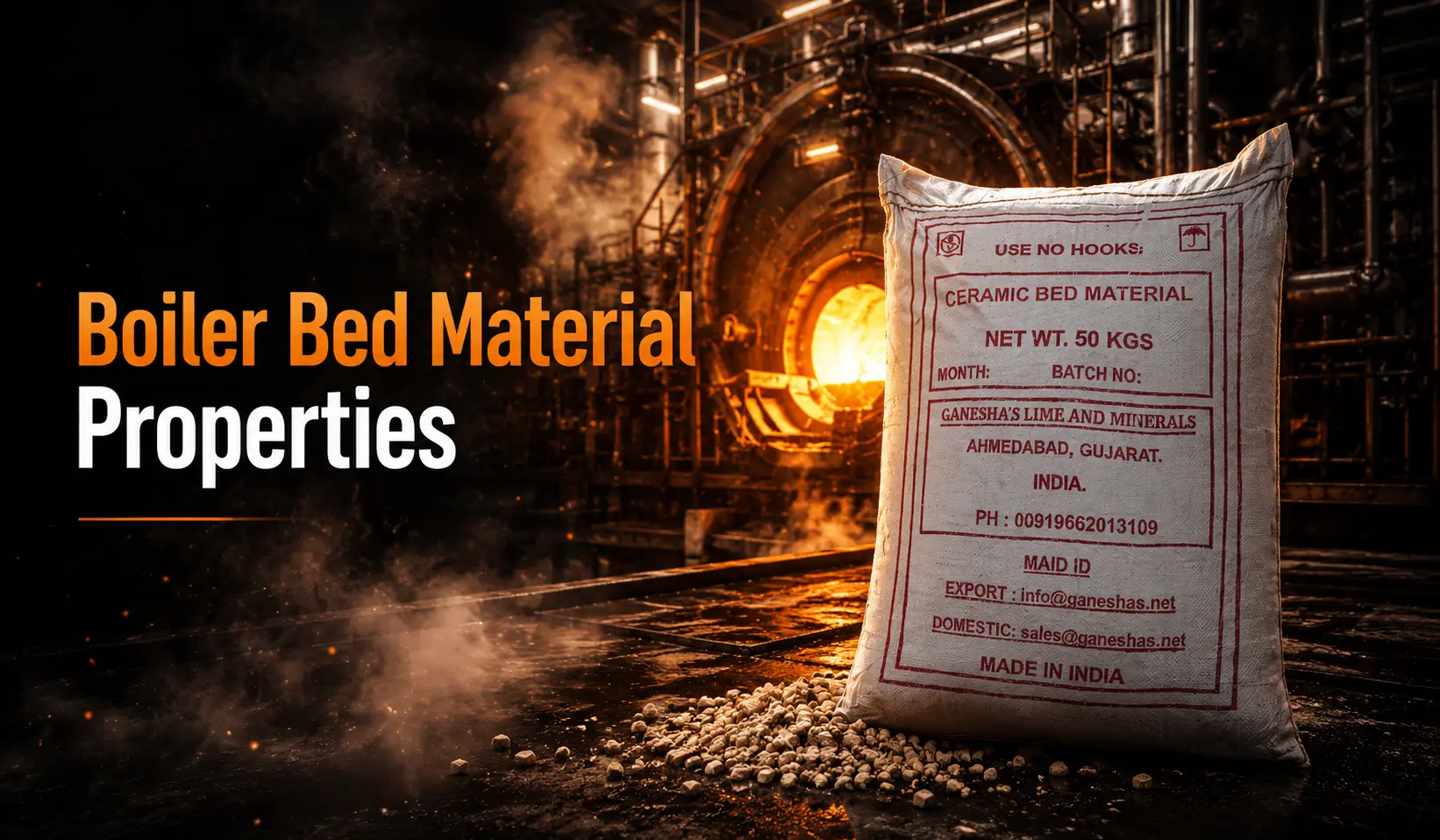
The bed material is the rough, solid stuff that lies at the bottom of the combustion chamber in a fluidized bed combustion system, especially an Atmospheric Fluidized Bed Combustion (AFBC) boiler. When high-velocity air is forced through this material from below, the particles behave like a fluid, creating a churning, highly turbulent zone where fuel is introduced and burned.
This fluidized layer serves multiple purposes: it distributes heat uniformly, sustains combustion temperature, and acts as a thermal reservoir that stabilizes the process even during fuel variability. Without a properly selected bed material, the entire combustion system becomes unpredictable.
The most common materials used include silica sand, alumina, and specialty refractory bed material compounds. Each comes with its own set of trade-offs in terms of cost, durability, and thermal performance.
Why Bed Material Properties Are Critical
The material for your bed is like the foundation of a building -it’s not pretty, but everything else depends on how good it is. Poor bed material composition leads to particle breakdown, sintering, defluidization, and accelerated wear on boiler internals.
Understanding and specifying the correct boiler bed material properties is essential for:
- Maintaining stable fluidization and combustion
- Protecting refractory lining from thermal shock
- Ensuring consistent heat transfer efficiency
- Reducing maintenance intervals and operational downtime
Ganesha’s Refractory and other suppliers like them have built their reputations on knowing these needs and providing materials that are engineered to exact specifications for tough industrial settings.
Key Properties of Boiler Bed Material
Here are some of the key properties of boiler bed material:
1. Particle Size and Distribution
The ideal particle size for boiler bed material typically falls between 0.5 mm and 1.5 mm for AFBC systems. This range ensures proper fluidization velocity without excessive carryover of particles into the flue gas path.
Too fine, and particles get entrained and lost. Too coarse, and the bed becomes sluggish, reducing heat transfer efficiency and creating hotspots. Most bed material specifications require a tight particle size distribution to maintain consistent fluidization behavior across the entire bed cross-section.
2. Bed Material Density
Bed material density directly governs the fluidization air velocity required and the pressure drop across the bed. Higher-density materials need more air to fluidize, affecting fan power consumption. Lower-density materials may fluidize at lower velocities but can be prone to attrition.
For AFBC boilers, a bulk density in the range of 1400–1700 kg/m³ is generally considered appropriate, though this varies depending on the specific boiler design and operating pressure.
3. Thermal Stability and Refractoriness
The material in the refractory bed has to be able to handle high temperatures all the time, usually between 800°C and 950°C in AFBC systems, without changing phases, melting, or sintering. Materials with high alumina content, such as those used in alumina refractory applications, perform especially well here.
Thermal stability also means resistance to thermal cycling. As boilers start up and shut down, the bed material experiences repeated expansion and contraction. Materials that crack or crumble under this stress can rapidly contaminate the bed, causing defluidization. The same thermal endurance principle governs the selection of Refractory Materials for Furnace lining in any high-heat industrial setup.
4. Chemical Inertness
The bed material composition must remain chemically stable in the combustion environment. It should not react with sulfur compounds, alkali vapors from fuel ash, or the products of combustion. Particle agglomeration is one of the main reasons for defluidization and unplanned shutdowns. It can be caused by materials in the reactive bed.
Silica sand, while cheap and widely available, can be susceptible to alkali attack at high temperatures. This is why refractory applications in modern AFBC boilers increasingly favor calcined alumina or mullite-based materials, particularly for high-sulfur or biomass fuels. Exploring the available Types Of Refractory Materials can help engineers narrow down the right chemistry.
5. Hardness and Attrition Resistance
The churning action inside a fluidized bed is mechanically aggressive. Particles collide with each other and with boiler internals thousands of times per hour. Bed material with low hardness wears down quickly, generating fines that exit with the flue gas and must be replenished frequently.
A good bed material specification calls for materials with a Mohs hardness of at least 6–7. This ensures an acceptable attrition rate that balances bed life with material cost. Boiler refractory lining also benefits when the bed material itself doesn’t generate excessive abrasive fines.
6. Sphericity and Shape
Rounded, near-spherical particles fluidize more uniformly and cause less erosion on tube surfaces compared to angular, irregular particles. On an industrial scale, it is very rare for particles to be perfectly round. However, the bed material specifications should include a sphericity requirement, usually above 0.7, to make sure that the fluidization behavior is predictable and the erosion rate is lower in the temperature control zone of the furnace.
How to Select Bed Material for AFBC Boilers
Choosing the best bed material for fluidized bed boilers involves balancing several competing factors:
Fuel type plays a large role. High-ash fuels introduce contaminants that can alter bed composition over time. High-alkali fuels demand chemically inert bed materials. Biomass systems often require bed materials with higher temperature tolerance.
Operating temperature determines the refractoriness requirement. Higher combustion temperatures narrow the field of suitable materials and generally favor alumina refractory options.
Availability and cost matter in long-term operations, since bed material is continuously consumed and must be regularly replenished. A technically superior but prohibitively expensive material may not be practical at scale.
Supplier reliability is equally critical. Working with an established manufacturer like Ganesha’s Refractory ensures consistent material quality, tested to the exact particle size distribution and chemical purity that your system demands.
For guidance on related materials used in combustion systems, it’s also worth reviewing the Importance Of Refractory Material and understanding the broader role of Refractory Materials in Furnace applications.
If you’re actively sourcing, we strongly recommend working with a qualified Boiler Bed Material Supplier who can provide certified batch testing and technical support.
Final Thoughts
The choice of bed material is not a matter of taste; it is an engineering matter. Having the right bed material properties makes sure that the boiler works well for a long time and that the fluidization stays stable. Underspecifying this material is one of the most common and costly mistakes in industrial boiler operation.
Whether you’re specifying materials for a new project or troubleshooting performance issues in an existing system, paying close attention to bed material composition, particle sizing, and thermal characteristics will always pay dividends. When you work with an experienced boiler bed material manufacturer, you won’t have to guess; you’ll be able to engineer.
Frequently Asked Questions
What is bed material in a boiler?
Bed material is the granular solid that forms the fluidized bed in the combustion chamber of fluidized bed boilers. It is usually silica sand, alumina, or refractory-grade material. It enables uniform heat distribution and stable combustion.
What are the important properties of bed material?
The most critical bed material properties include particle size distribution, density, thermal stability, chemical inertness, hardness/attrition resistance, and particle shape (sphericity). All of these directly impact boiler efficiency and operational reliability.
Which material is commonly used as boiler bed material?
Silica sand is the most commonly used material due to its availability and cost. However, calcined alumina, mullite, and other high-grade refractory materials are increasingly preferred in demanding applications where temperature or chemical conditions exceed what sand can tolerate.
What is the ideal bed material for AFBC boilers?
For most AFBC boilers, a high-purity calcined alumina or alumina-silica material with a particle size of 0.5–1.5 mm, bulk density of 1400–1700 kg/m³, and low attrition rate is considered ideal. The specific choice depends on fuel type, operating temperature, and economic constraints.