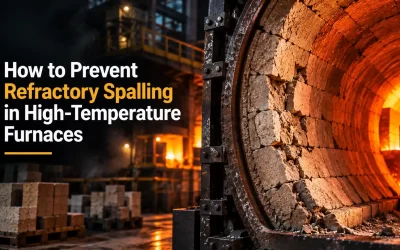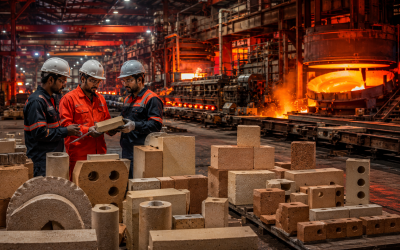
Ever wondered what keeps the hot furnaces of steel mills, glass factories, and cement plants running smoothly without melting down? The secret lies in a remarkable refractory material known as high alumina bricks. These unsung heroes of the industrial world are designed to withstand extreme temperatures and harsh conditions, ensuring that heavy-duty processes go off without a hitch.
But here’s the catch… high alumina bricks are much more than just heat-resistant blocks. Their unique composition and properties make them indispensable in a variety of demanding environments.
As a leading high alumina bricks manufacturer and supplier, Ganeshas Refractory compelled a comprehensive guide on valuable insights of high alumina bricks. So, without further ado – let’s understand the basics and make an informed choice.
What is a High Alumina Brick?
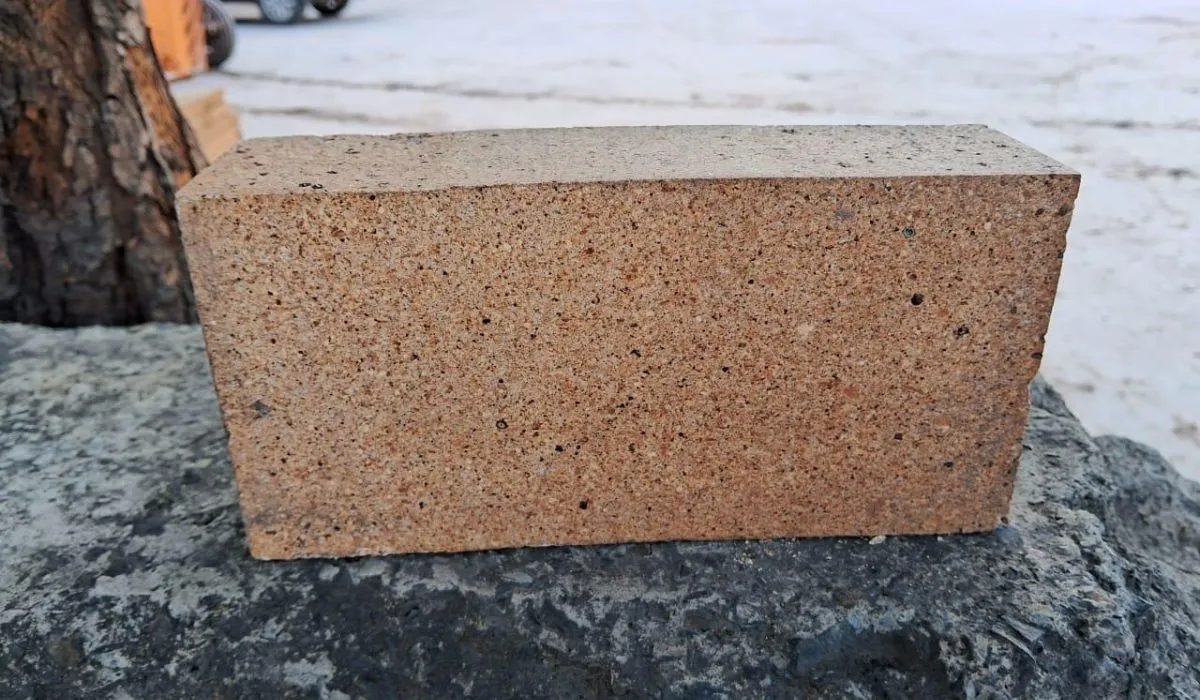
High alumina bricks are one of the best-selling refractory materials of the year 2024. These types of bricks are composed of aluminium oxide (Al2O3) at levels typically exceeding 48%, along with other raw materials such as fireclay, and various additives that contribute to their unique properties.
As a leading high alumina brick manufacturer in India, Ganeshas Refractory follows a comprehensive manufacturing process. The production of high alumina bricks involves carefully controlled processes such as grinding, mixing, shaping, drying, and firing at elevated temperatures to achieve the desired result.
What are the Impressive Properties of High Alumina Bricks?
High alumina bricks play a crucial role in various industrial processes due to their unique properties and exceptional heat resistance. Here’s an in-depth look at the properties of high alumina bricks that make them listed as best selling refractory material:
Upto 1800°c High-temperature Resistance
Industries such as steel, cement, glass, and ceramics rely on high alumina bricks to line kilns, furnaces, and other equipment that operate at extremely high temperatures. High alumina bricks are more temperature resistant than other bricks because they have a higher alumina content, which improves their refractoriness. It has been said the higher the alumina content the better the temperature resistance properties.
1.0 to 2.5 W/mk Thermal Conductivity
High alumina bricks offer low thermal conductivity, which helps conserve energy and maintain the desired temperature inside industrial applications. High alumina bricks demonstrate thermal conductivity ranging from 1.0 to 2.5 W/mK. Lower thermal conductivity reduces heat loss and ensures more uniform temperature distribution, enhancing process efficiency and reducing energy consumption.
Approx 40 MPA Cold Crushing Strength
Cold-crushing strength properties of high alumina bricks varied in different grades and other essential factors. This property indicates their ability to withstand compressive forces without crumbling at room temperature. The CCS value is crucial in evaluating the robustness and load-bearing capacity of high alumina bricks in applications.
65% Chemical & Abrasion Resistance
Every brick has its own unique value contributing to the properties. High alumina bricks have good chemicals and abrasion compared to regular refractory bricks but vary. The use of high alumina bricks helps to protect equipment from wear and deterioration. Their resistance to chemical attack and abrasion ensures the longevity of the lining in high-temperature environments.
3 Main Variants Based on Alumina Content:
There are numerous properties of high alumina bricks, which vary depending on the type and grade. Based on their alumina content, high alumina bricks are divided into several grades; higher alumina bricks are more refractorily and resistant to spalling at high temperatures.
Classification of High Alumina Bricks
Grade I High Alumina Bricks – more than 75% Al2O3 content.
Grade II High Alumina Bricks – 60-75% Al2O3 content.
Grade III High Alumina Bricks – 48-60% Al2O3 content.
A Quick Overview at the Table of Alumina Bricks
Before you look at the table, we must first clarify something: the properties of alumina bricks stated aforementioned, as well as the details provided in the table below, vary depending on an array of constraints.
The table below provides a general overview and fundamental understanding of alumina bricks. To get more reliable and accurate product details, we suggest contacting the top high alumina brick manufacturers, such as Ganeshas Refractory. Inquire today!
| Property | Description |
| Alumina Content | Typically ranges from 45% to 99%, depending on the grade |
| Maximum Service Temperature | Up to 1,800°C (3,272°F) |
| Bulk Density | Typically 2.3 to 2.7 g/cm³ |
| Cold Crushing Strength | Ranges from 30 to 100 MPa, depending on the grade |
| Apparent Porosity | Generally between 15% and 25% |
| Thermal Conductivity | Varies with temperature, typically 1.0 to 2.5 W/mK |
| Chemical Resistance | Excellent resistance to acidic and basic slags |
| Thermal Expansion | Low thermal expansion, enhancing stability under thermal cycling |
| Refractoriness Under Load (RUL) | Up to 1,600°C, ensuring structural integrity under load at high temperatures |
Bottom Line
In conclusion, high alumina bricks are a pivotal component in various industrial processes, offering exceptional heat resistance, mechanical strength, and resistance to thermal shock, corrosion, and abrasion. They are vital for lining furnaces, kilns, and high-temperature equipment in industries such as steel, cement, glass, ceramics, etc.
Ganeshas Refractory, as a leading industry player, has demonstrated a strong commitment to manufacturing and supplying certified refractory materials worldwide. Whether you need high alumina bricks, low alumina bricks, castable, cement or other refractory materials, our team is here to help. Get in touch with us for further details.